What Is Uptime? Availability and the Nines, Explained
It is 8:55 pm and a bill is due at midnight. You open your bank's app, it spins for a while, then says "Something went wrong". You try again at 9:05 and it works. For those ten minutes the bank was closed as far as you were concerned. This lesson answers the question what is uptime: how teams measure the time a service really works, what a promise like "99.9%" allows, and why a service can look "up" while still letting you down.
Uptime is a percentage of time
Uptime is the share of time a service was working, written as a percentage. The sum is simple: minutes it worked, divided by the total minutes in the period, times 100. Its opposite is downtime, the minutes it did not work. A service here means anything people use over a network: a website, the system behind an app, a payment gateway.
The hard part is deciding what "working" means. The cheapest check is a ping, a tiny network message that asks a computer "are you there?" A reply proves the machine is switched on and reachable. It does not prove that the website on it loads. A better check asks for a real page and expects the right answer, quickly.
Most teams measure uptime with an uptime checker: a program outside their own systems that sends a request every minute, often from several cities, and records each answer. If the page came back correctly within a time limit, that minute counts as up. If it returned an error or took too long, the minute counts as down.

The nines, in minutes
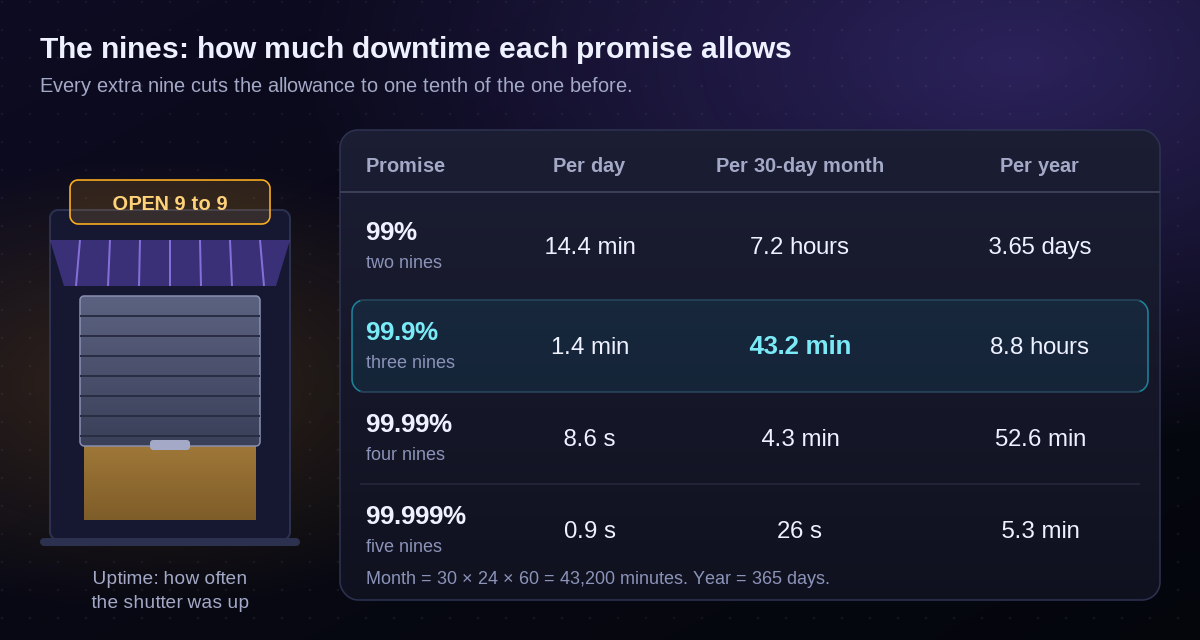
Uptime targets are usually described by how many nines they contain, so "three nines" means 99.9%. The numbers look almost identical, but the gap is large once you turn them into time. A 30-day month has 30 × 24 × 60 = 43,200 minutes. A 99% promise allows 1% of that as downtime: 432 minutes, or about 7.2 hours.
Each extra nine divides the allowance by ten. 99.9% allows about 43 minutes a month. 99.99% allows about 4.3 minutes. 99.999%, called "five nines", allows about 26 seconds, which is less time than it takes most engineers to read the first alert.
Why each extra nine costs more
Each nine is harder to earn than the last. To survive a server failing, you need a spare server and something that moves traffic to it automatically, which is called redundancy. To fix problems within minutes, someone must be on call: ready to respond day and night. To avoid breaking things yourself, every change needs more testing and a quick way to undo it. Four nines usually means running in more than one data centre.
That is why 100% is not a sensible target. Your users reach you through home Wi-Fi, mobile networks and phones that fail far more often than a well-run service, so someone whose connection drops 1% of the time cannot tell 99.99% from 100%. Chasing the last fraction would also mean never changing anything, because every change carries some risk. Teams pick the lowest target that keeps users happy and spend the rest on improvements.
Planned, unplanned and "up but broken"
Downtime comes in two kinds. Planned downtime is announced in advance, such as a database upgrade on Sunday at 2 am. Unplanned downtime is an outage nobody wanted: a bad release, a full disk, a cloud region in trouble. Some contracts leave announced maintenance out of the sum, so always read what a promise counts.
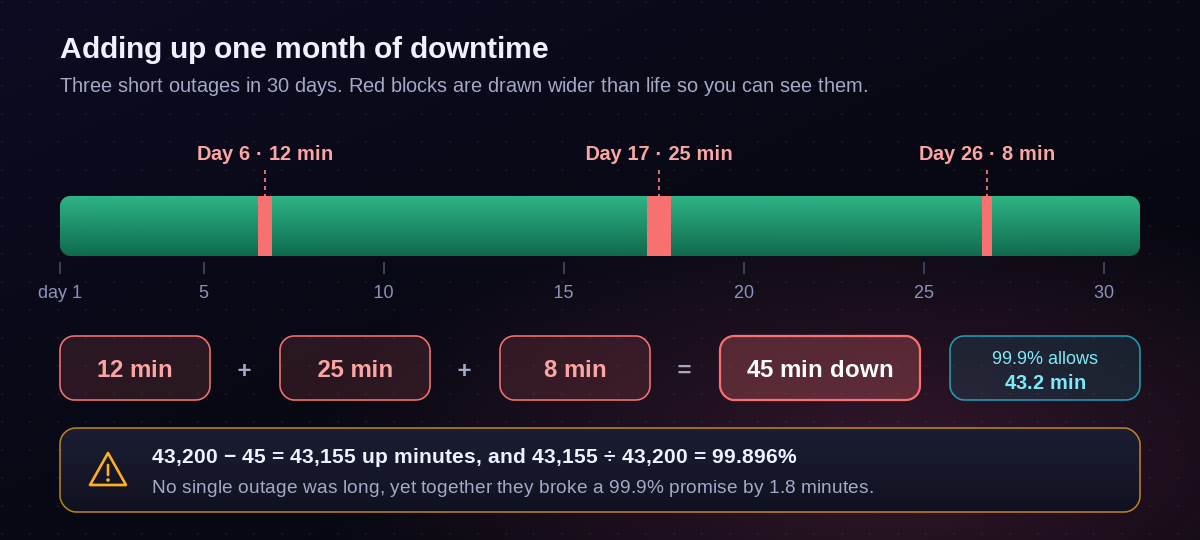
Downtime also adds up over the period. Three outages of 12, 25 and 8 minutes each feel minor on the day, yet together they spend more than a whole month's 99.9% allowance.
Finally, a service can be "up" and still fail its users. Pages may take 20 seconds to load. Search may return the wrong results. Payments may fail for one bank's cards while everything else works, which is a partial outage. A checker that only asks "did anything answer?" misses all three, so good checks look for the right content, set a time limit, and test the journeys users care about.
Where you will meet uptime numbers
Status pages are public web pages where a company shows whether each part of its service is working and posts updates during an incident. Many draw a row of green, yellow and red bars, one per day, for the last 90 days.
Cloud providers publish a service level agreement (SLA), a contract that states the uptime they promise and what they give back if they miss it. The Amazon Compute SLA, for example, sets monthly uptime percentages and refunds part of your bill as service credits when Amazon falls short.
Companies that sell software to other businesses make similar promises in their customer contracts. When you see a percentage there, convert it to minutes using the table above, then check what counts as "down" and what is left out.
Check yourself
A service promises 99.9% uptime. Roughly how much downtime does that allow in a 30-day month?
About 43 minutes, because 0.1% of the month's 43,200 minutes is 43.2.
A ping to your server gets a reply every time, but customers say the site will not load. Is the site up?
Not in any way users care about: a ping proves the machine answers, not that the website serves correct pages in time.
Why don't teams aim for 100% uptime?
Each nine costs far more than the last, users' own networks fail more often than that, and avoiding all risky change would stop the product from improving.