AI vs Machine Learning vs Deep Learning, Explained
You have probably seen one app called "AI-powered" on its website, "built with machine learning" in a news story, and "driven by deep learning" in a job advert. These are not three names for the same idea. The question of AI vs machine learning, with deep learning added on, has a neat answer: each term sits inside the one before it. Once you see that nesting, headlines and product pages become much easier to read.
Three dolls, one inside the other
The three words describe circles of different sizes. Artificial intelligence (AI) is the whole field of making computers do tasks that we would normally say need intelligence. Machine learning (ML) is one way of doing AI. Deep learning is one way of doing machine learning.
People mix the words up because the smallest doll gets almost all the attention today, so a news story says "AI" when it means one particular deep learning system. That is not wrong, because the inner dolls are still AI. It is just less precise.
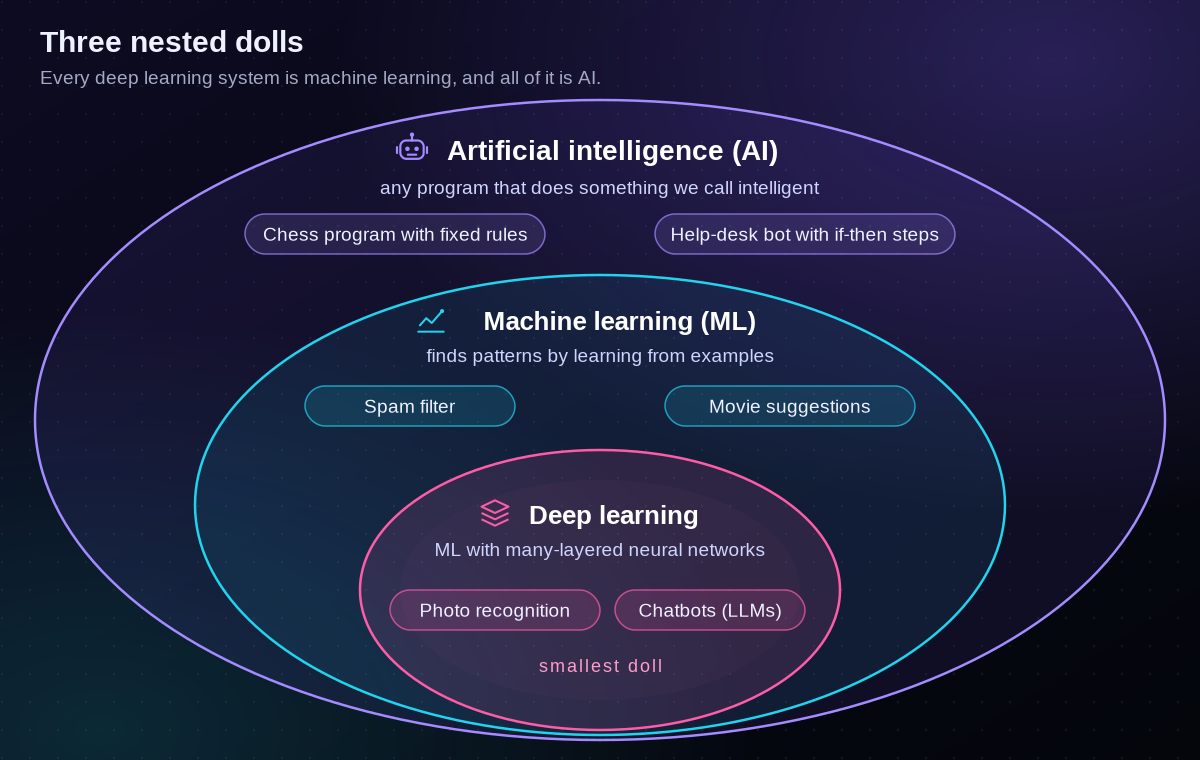
AI: the biggest doll
AI is a broad label for any program that does something we would call intelligent if a person did it: playing chess, planning a route, understanding speech or answering a question. The field got its name in 1956, long before today's chatbots, and for decades most AI worked by following rules that people wrote by hand.
A classic chess program is a good example. Its programmers wrote rules for judging a position, such as "a queen is worth about nine pawns" and "controlling the centre is good". The program then searched through possible moves and picked the one its rules scored highest. It could play well, but it only ever knew what its programmers had told it.
A help-desk bot that follows if-then steps works the same way: if the customer types "refund", show the refund page. Some people would not call something this simple intelligent, and the edge of the biggest doll is indeed fuzzy. The point is that a person wrote every rule.
Machine learning: rules learned from examples
Hand-written rules break down when the world is messy. Try writing rules that catch every spam email. Spammers change their wording every week, and a rule such as "block any email containing the word prize" also blocks the genuine message telling you that you won the office quiz. You would never finish.
Machine learning turns the job around. Instead of writing the rules, you give the computer many examples together with the right answers, and it works out the pattern itself. For a spam filter, the examples are emails and the answers are labels saying "spam" or "not spam". Many of those labels come from people pressing the Report spam button.
The pattern the computer finds is called a model: a large set of numbers, learned from the examples, that turns a new input into an answer. A film streaming service builds a similar model from what millions of people watched, so it can suggest a film you have not seen yet.
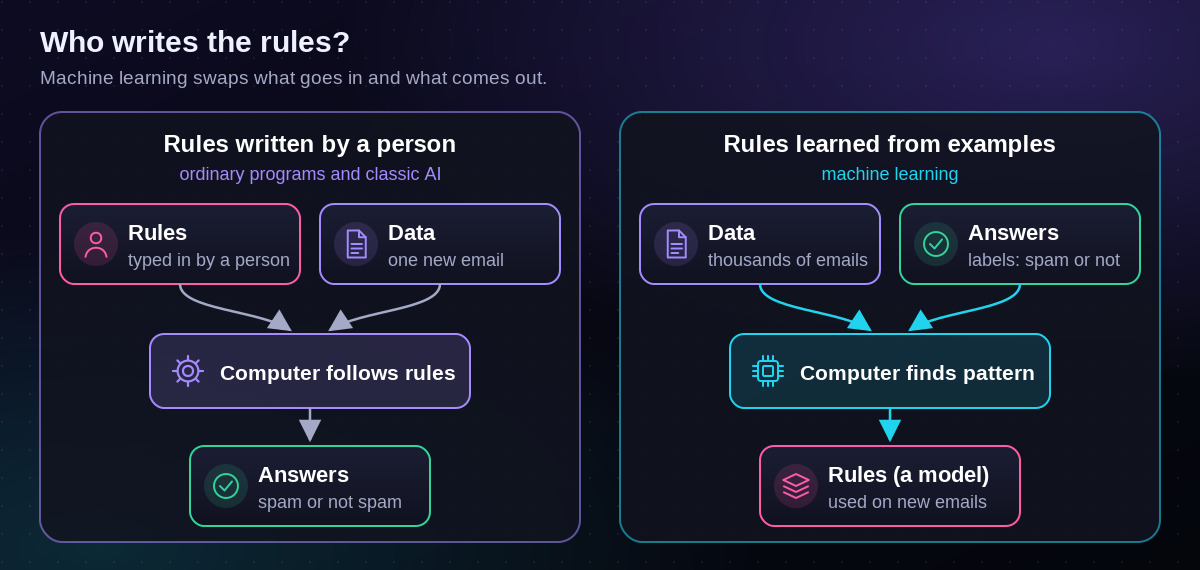
Look at where the pink "Rules" box sits in each half of the diagram. On the left a person supplies it at the top. On the right it comes out at the bottom, produced by the computer. That swap is the whole difference between the outer doll and the middle one.
Deep learning, and where chatbots fit
Deep learning is machine learning that uses a particular kind of model called a neural network: layers of simple number-crunching units, loosely inspired by brain cells, where each layer passes its results to the next. "Deep" just means the network has many layers stacked up, often dozens. A later lesson in this section opens one up.
Deep learning took off around 2012, when big collections of labelled photos and fast graphics chips made large networks practical. It now powers image recognition, voice assistants that turn speech into text, and chatbots.
Chatbots such as ChatGPT, Gemini and Claude are built on large language models (LLMs): very large neural networks trained on huge amounts of text. That puts them in the smallest doll. They are deep learning, which makes them machine learning, which makes them AI. All three labels are true; "LLM" is simply the most precise one.
One caution: the dolls describe a system's main technique. Real products often mix all three, for example a chatbot that runs a deep learning model inside hand-written rules that block certain requests.
A quick sorting game
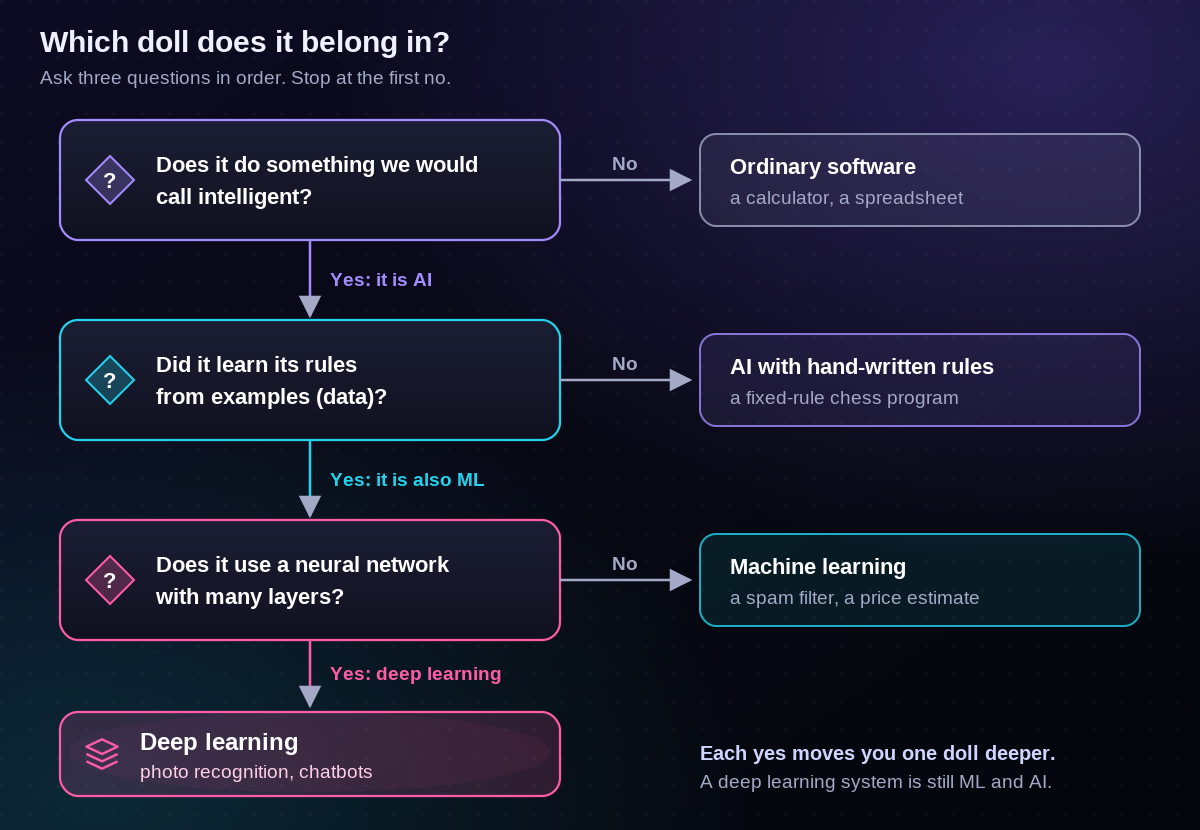
Use the three questions in the flowchart below to sort six everyday systems. Decide for each one before you read the answers underneath.
- A calculator app adding up a restaurant bill.
- A route planner that finds the shortest path by searching a road map with fixed rules.
- A website that estimates a house's price from its size and area, learned from thousands of past sales.
- A model that predicts tomorrow's ice-cream sales from the weather forecast, learned from two years of sales records.
- Your phone's photo app finding every picture of a dog.
- A chatbot that drafts an email for you.
The calculator is ordinary software, outside all the dolls, because adding numbers follows fixed arithmetic. The route planner is AI with hand-written rules, the outer doll only; searching for routes is one of the oldest AI techniques. The house price and ice-cream models are machine learning, because their rules come from past data. The photo app and the chatbot are deep learning, and the chatbot is an LLM.
Check yourself
Is every AI system a machine learning system?
No. A chess program built only on hand-written rules is AI but learns nothing from data, so it sits in the outer doll only.
When a machine learning model is trained, what goes in and what comes out?
Examples and their right answers go in, and a model comes out: the learned rules that you then use on new examples.
A friend says a chatbot "isn't machine learning, it's AI". What would you tell them?
It is both. The chatbot runs on a large language model, which is deep learning, and every deep learning system is also machine learning and AI.