Prompt Engineering Basics: How to Brief an AI
Your manager asks for a short note about a delayed project, so you type "write an email about the delay" into a chatbot. Back come three polished paragraphs that apologise for the wrong thing, in a tone you would never use. The model did not fail; the brief did. Prompt engineering basics are the habits that fix this: telling the model clearly what you want, in a form it can use.
Why a vague prompt gets a vague answer
A prompt is the text you send to the model. Prompt engineering is the practice of writing and refining prompts so the results are useful and repeatable. No coding is involved; it is closer to writing a good brief.
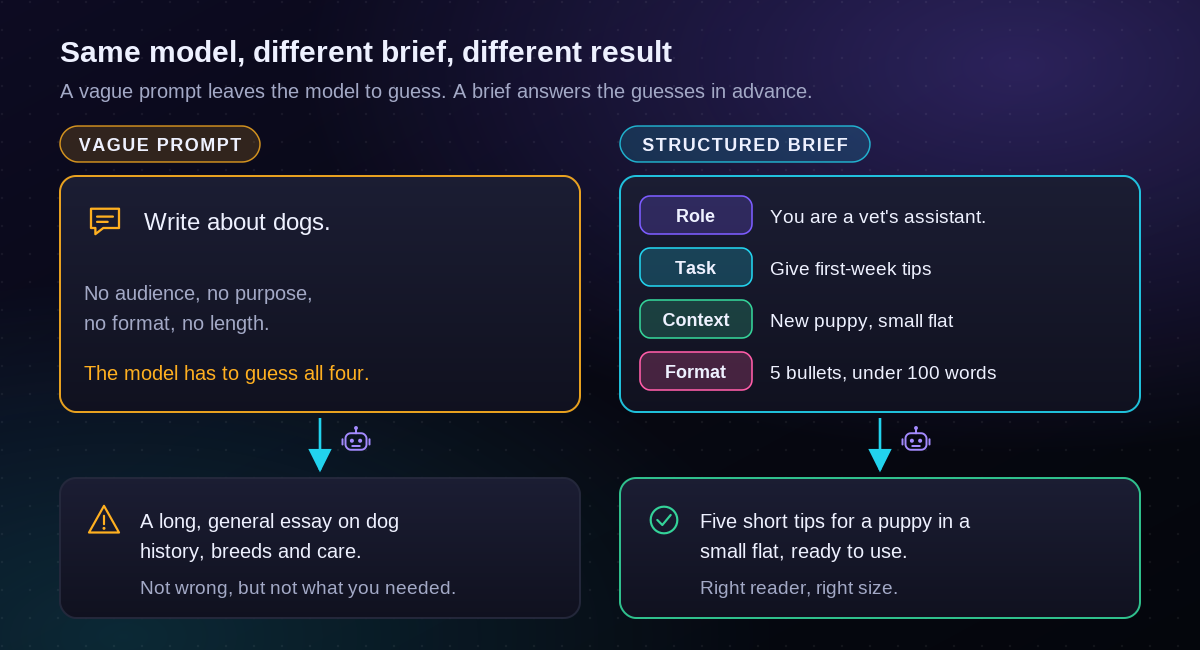
Recall from What Is an LLM? that the model continues the text it is given with likely tokens. When the prompt says very little, the most likely answer is the most average one: a general reader, a medium length, a safe tone. The model rarely stops to ask what you meant unless you invite it to.
The parts of a good brief
Most strong prompts contain some mix of five parts. Role or audience says who the model should act as, or who the answer is for, such as "explain it for a 12-year-old". This changes vocabulary and depth.
The task is the job itself, best stated with a clear verb: summarise, compare, draft, list. The context is everything the model cannot know: your situation, the purpose, and any facts or text it should work from.
The format describes the shape of the answer: bullet points, a table, an email, one line per item. Constraints are the limits: length, tone, and anything to avoid.
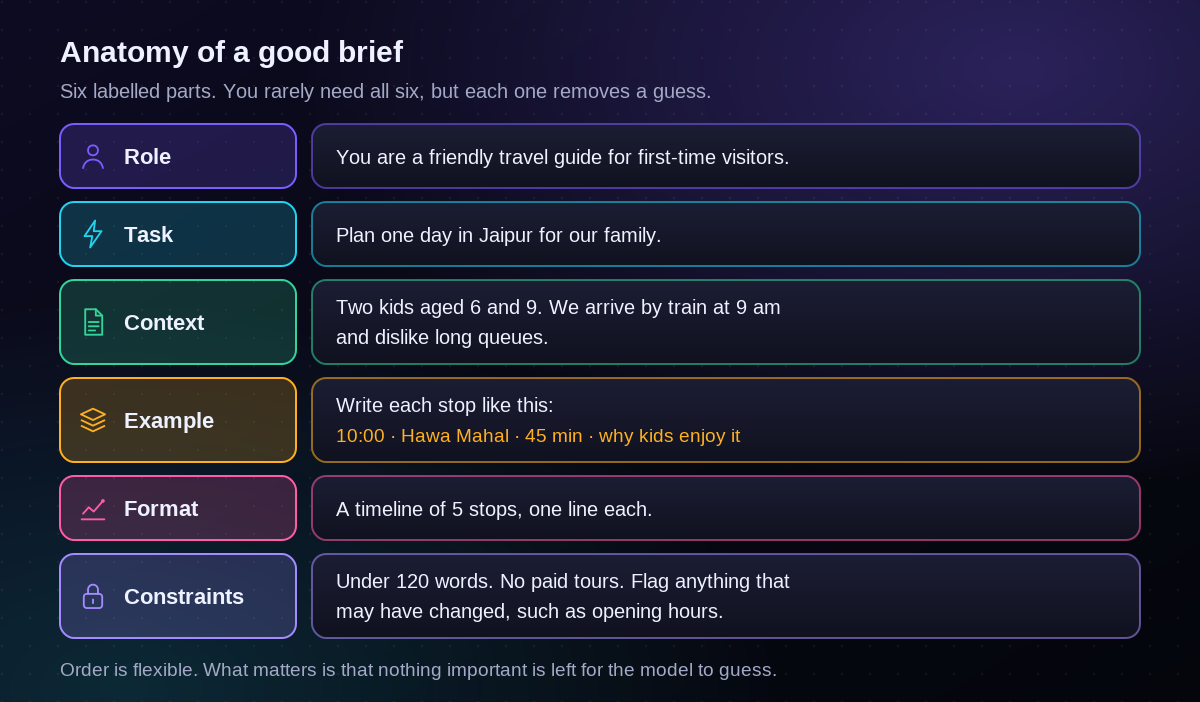
The order of the parts is flexible. You will not need all of them every time; a quick question may need only a task and a length.
When you paste in material for the model to work on, mark clearly where it starts and ends. Quotation marks, triple quotes or a heading all work. These markers, called delimiters, help the model tell your instructions apart from the text it should process. Here is a short prompt that uses them:
Summarise the customer review between the triple quotes
in 3 bullet points for our support team.
If the review asks for money back, put that bullet first.

"""
Ordered a pressure cooker on 3 March. It arrived with a
cracked lid, and the replacement took two weeks. Support
was polite but slow. I want my delivery fee refunded.
"""
Notice how each line does one job. The first two lines give the task, the audience and the format. The third adds a rule that matters to your team. The review itself sits inside the quotes, so the model will not mistake "I want my delivery fee refunded" for an instruction to you.
Show, do not just tell
Describing the output you want helps. Showing it helps even more. Including one or two examples of the desired output in your prompt is called few-shot prompting. Here a "shot" means an example: zero-shot is no example, one-shot is one, few-shot is a handful.
Examples strongly guide format, length and style, often better than a description could. The Jaipur template above uses a single example line, "10:00 · Hawa Mahal · 45 min · why kids enjoy it", and the model will usually copy that pattern for every stop.
The flip side is that the model may copy an example too closely, repeating its length or even its words. If you give several examples, make them differ in the ways you are happy for the answers to differ.
Tricky tasks: ask for steps, split the work, refine
For a problem with several steps, such as working out a trip budget, ask the model to work through the steps before giving its final answer. Each step it writes becomes part of the text it reads next, so later steps can build on earlier ones. Some newer models, often called reasoning models, do this automatically before they reply.
For a big job, split it into smaller prompts. Rather than "write my whole project report", ask for an outline first, check it, then ask for each section. Every piece is easier to check and fix, and each request stays comfortably inside the context window.
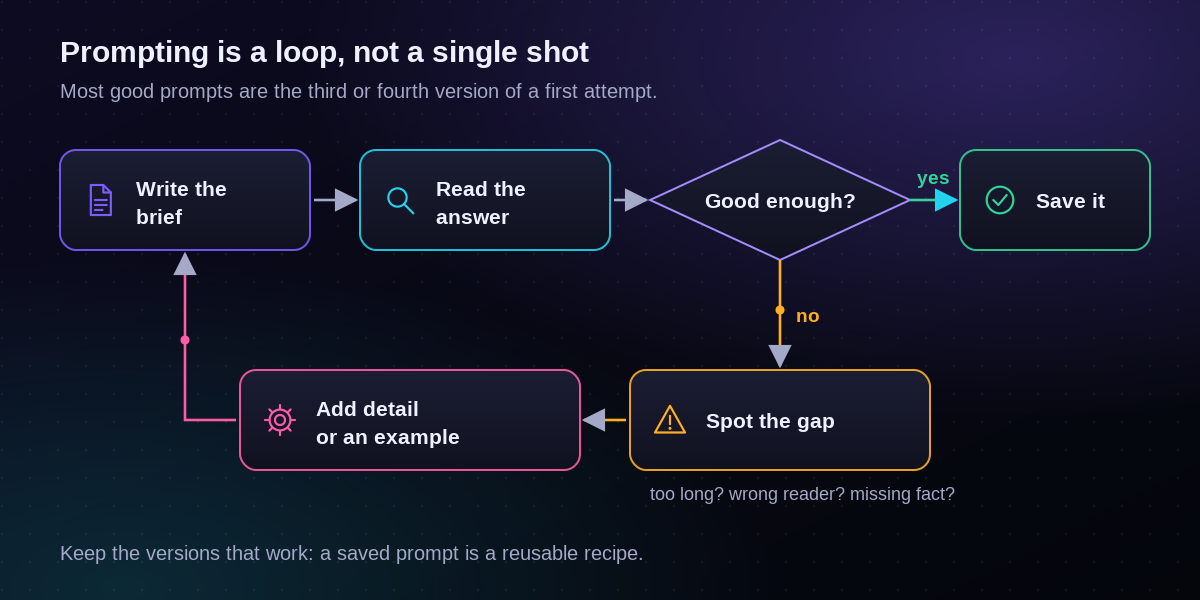
Finally, treat prompting as a loop. Read the answer, name what is off, change one thing in the brief and try again. Keep the prompts that work in a note, because a saved prompt is a reusable recipe.
What prompting cannot do
A prompt shapes how the model uses what it already has. It cannot add knowledge the model does not have. If a fact is neither in its training nor in your prompt, a better brief only produces a more polished guess.
No magic phrase changes this. "You are a world-class expert" does not give the model new facts. When facts matter, paste them in as context, and still check anything important. The next lesson explains why models sometimes state invented details with complete confidence.
Check yourself
Why does "Write about dogs" tend to produce a generic essay?
With no audience, purpose, format or length given, the most likely continuation is the most average answer.
What is few-shot prompting?
Putting a few examples of the output you want into the prompt, so the model follows their format and style.
You write a perfect brief asking for your company's private 2026 holiday list. What will happen?
The model cannot know it, so it will say so or guess; paste the real list in or check the official source.