Training vs Inference: Why AI Needs GPUs
Ask a chatbot a question and the answer starts appearing within a second or two. Yet the model behind it took weeks of computing and a very large electricity bill to build. Both facts are true because every AI model lives through two very different phases. Understanding training vs inference explains why AI companies buy chips by the thousand, why some AI features run on your phone while others need the internet, and where the cost of AI actually goes.
Two phases: studying and the exam
Training is the phase in which a model learns: its weights, the adjustable numbers you met in the neural network lesson, are changed again and again until its answers are good. Inference is the phase in which the finished model is used: a new input goes in and an answer comes out, with the weights left exactly as they are.
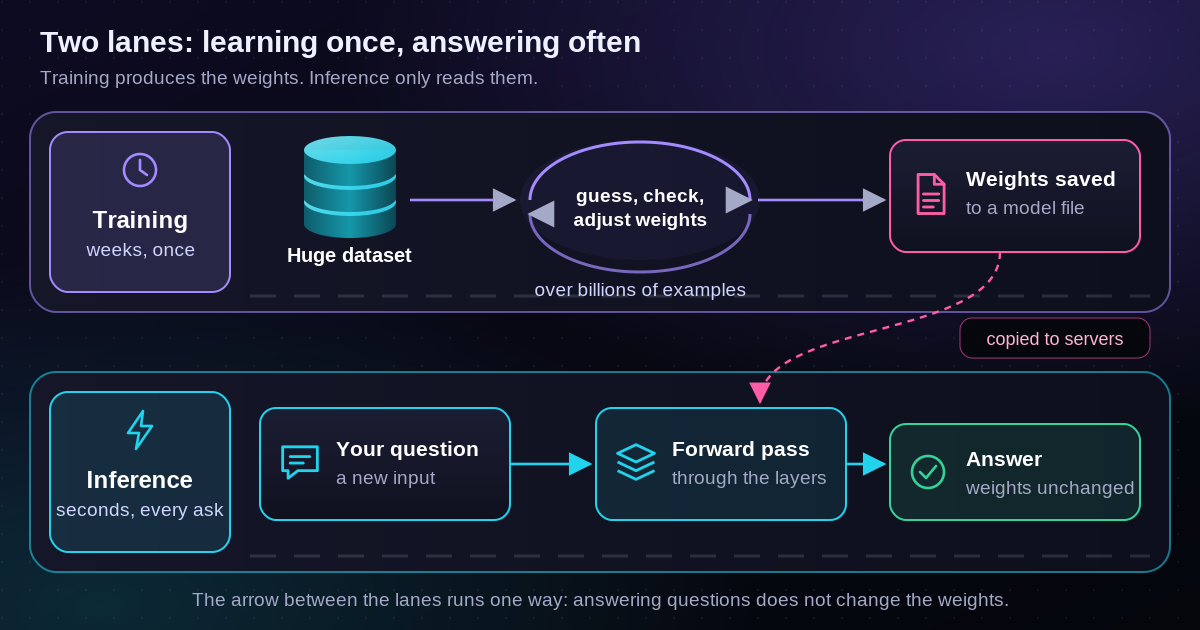
Notice what crosses between the two lanes in the diagram: just a file of numbers. Everything the model learned during training is inside that file, and inference only reads it.
What happens in training
Training runs the learning loop from how machine learning works. The model makes a guess for a batch of examples, the error is measured, backpropagation works out how each weight should change, and every weight is nudged. Then the next batch comes along, and the next.
For a large modern model this loop runs over billions of examples and adjusts billions of weights on every step. That takes weeks or months on thousands of chips working together in a data centre, and it can cost tens of millions of dollars. When it finishes, the weights are saved to a file. From then on they are frozen: they do not change unless someone trains the model again.
What happens in inference
Inference is much simpler. The input, such as a photo or your question, is turned into numbers and flows through the network once, layer by layer, from input to output. This single trip is called a forward pass. No error is measured and no weight is changed, so a forward pass is far cheaper than a training step.
There is one detail worth knowing about chatbots. They write their reply a small piece at a time, roughly a word or part of a word, and each piece needs its own forward pass. A long answer therefore takes hundreds of passes, which is why you see the text appear gradually. It also means your chat does not retrain the model; the weights stay frozen while it answers you.
Why AI needs GPUs
Both phases are mostly one kind of work: multiplying big grids of numbers, inputs by weights, and adding up the results. That is exactly what each neuron does, repeated for every neuron in every layer. The useful property is that most of these sums do not depend on each other, so they can all be done at the same time.
A CPU, the main chip in every computer, has a few powerful cores (typically 4 to 16 in a laptop), each built to handle varied, step-by-step work quickly. A GPU, or graphics processing unit, was designed to colour millions of screen pixels at once, so it has thousands of simpler cores that all do the same small sum on different numbers. That design happens to fit neural networks perfectly.
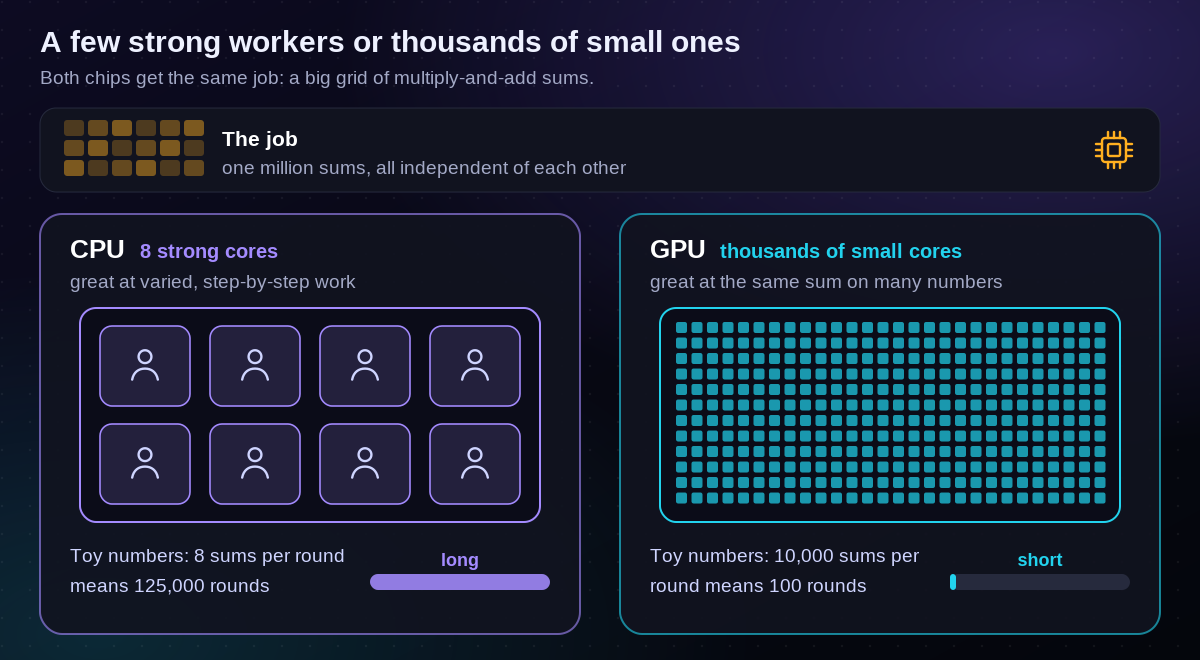
The numbers in the diagram are a toy. Real CPU cores are faster than GPU cores and can each do several sums at once, so the real gap is smaller. But for the huge grids inside neural networks, a GPU still finishes many times sooner. Memory matters too: the weights must sit in the GPU's own fast memory. A model with 70 billion weights, stored at 2 bytes each, needs about 140 GB, so big models are often split across several GPUs.
Cost, and where each one happens
One training run costs far more than one answer. But a popular model may answer millions of questions a day, and every answer needs chips, memory and electricity. Users also expect replies within seconds, so the chips must be ready and close at hand. Over a model's life, the total spent on inference can match or exceed the cost of training it.
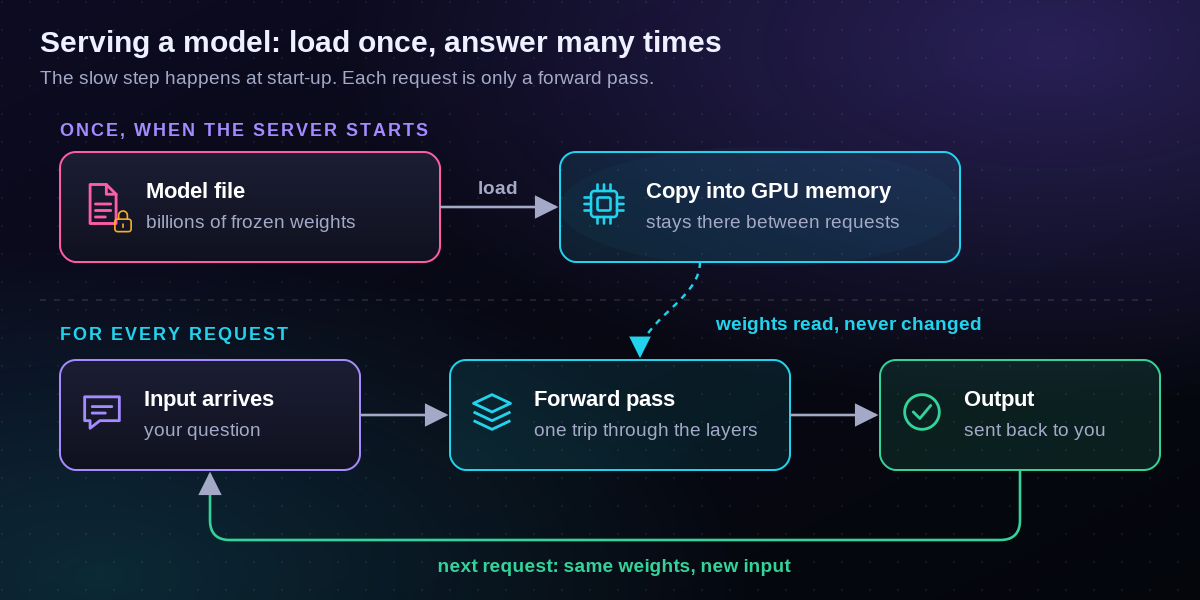
In real life the two phases happen in different places. An AI lab or company trains a model once per version, in a data centre. Inference then runs wherever the users are. Big chatbots run on racks of GPUs in data centres, while smaller models run on your phone's own AI chip, often called a neural engine or NPU, for features such as face unlock and keyboard suggestions.
Check yourself
Does a chatbot's model learn from your conversation while it answers?
No. During inference the weights are frozen, so the model only reads them; changing them would require another round of training.
Why is a GPU faster than a CPU for neural networks, even though each GPU core is simpler?
Most of the sums in a network are independent, so thousands of simple cores working at once beat a few strong cores working in turn.
Why can inference end up costing more than training?
Training is paid once per version, but inference is paid on every request, and a popular model can serve millions of requests a day.